

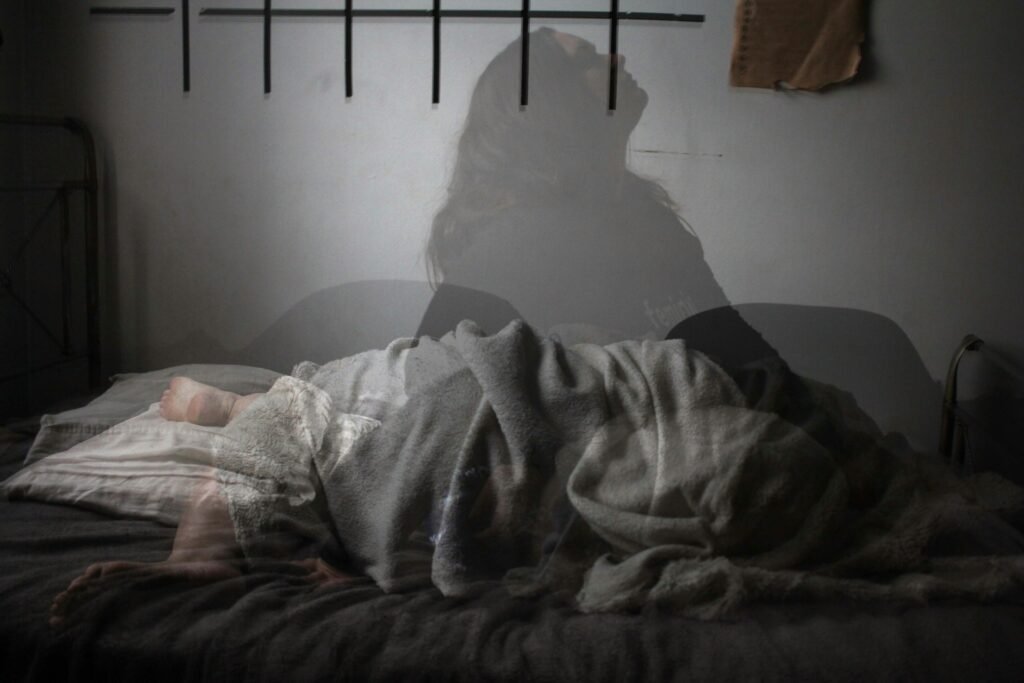
You wake up. The room looks exactly as it should, but you can’t move. Not your arms, not your legs, sometimes not even your voice. For a few seconds, maybe longer, you’re completely conscious and completely still, and it can feel utterly terrifying.
If this has happened to you, you’re far from alone. Sleep paralysis is one of the most common (and most misunderstood) sleep experiences there is. This article covers why it happens, what to do in the moment if it does, and how hypnotherapy can help if it keeps coming back.
What is sleep paralysis?
Sleep paralysis happens at the border between sleeping and waking. During REM sleep, the stage where most vivid dreaming occurs, your mind switches off movement in your muscles. It’s a built-in safety mechanism that stops you from physically acting out your dreams.
Ordinarily, that muscle “switch” flips back on the moment you wake up, so you never notice it happened at all. Sleep paralysis is what happens when your mind wakes up a fraction faster than your body does. You’re alert and aware, but your body hasn’t caught up yet. It typically lasts somewhere between a few seconds and a couple of minutes, and it always resolves on its own.
Why does sleep paralysis feel so frightening?
Waking awareness combined with total physical stillness is unsettling on its own. Add to that the fact that many episodes come with a strong sense of presence in the room, pressure on the chest, or vivid hallucinations, and it’s easy to see why sleep paralysis has such a fearsome reputation.
It’s also why it turns up in folklore around the world under different names, often described as a figure sitting on the sleeper’s chest. The details vary, but the underlying experience is remarkably consistent wherever you look, which tells you something important: this is a shared human experience with a real explanation, not a sign that something is wrong with you personally.
What to do if sleep paralysis happens to you
There’s no proven way to instantly end an episode once it’s begun, but there are things you can do to bring your fear response down while you wait for it to pass. Try this the next time it happens:
- Remind yourself what it is. Say it in your head: this is sleep paralysis, it is temporary, and it will pass. Naming it takes some of its power away.
- Focus on your breath, not your body. You can breathe normally, even though it may not feel like it. Slow, steady breathing helps calm the fear response.
- Try to move something small. A finger, a toe, your tongue. Small movements are often easier to initiate than trying to move your whole body at once, and can help bring the episode to an end sooner.
- Resist the urge to fight it. Struggling against the paralysis tends to heighten panic. A calmer, more accepting stance, as strange as that sounds in the moment, usually helps it pass more quickly.
Afterwards, try not to leap straight back into normal activity or scroll your phone. Give yourself a minute to settle, with the lights on if that helps, before going back to sleep again.
What causes it, and why does it recur for some people?
Isolated episodes can happen to anyone and are usually linked to short-term disruption: an irregular sleep schedule, jet lag, sleeping on your back, stress, or a period of poor-quality sleep. For most people, it happens once or twice and never becomes a pattern.
For others, it recurs. And this is where an important cycle often takes hold. One frightening episode creates anxiety about sleep itself. That anxiety fragments sleep further, disrupting the very sleep patterns that made an episode more likely in the first place. Fear feeds the sleep disruption, and the sleep disruption feeds the fear.
This is worth understanding clearly: recurring sleep paralysis is very often less about the episodes themselves, and much more about the fear response that builds up around them.
How hypnotherapy can help
This is where my work comes in. I don’t approach sleep paralysis as something to be fixed at the level of the muscles or the sleep stage; that part of the process is entirely normal. I approach it as a fear pattern, held in the mente subconscia, that can be worked with directly.
In session, this can involve:
- Reframing the experience: shifting the meaning your subconscious has attached to the sensation, from threat towards “my body is between states, and I am safe.”
- Calming the nervous system: reducing the background anxiety and hypervigilance around sleep that keep the cycle going.
- Suggestion work for future episodes: building a calmer automatic response in advance, so the reaction shifts from panic towards recognition.
- Revisiting a past episode in hypnosis, only when a client feels ready: taking the emotional charge out of the memory itself, always at their pace.
Because so much of my work sits at the intersection of sleep and dreaming, I also often bring in elements of dream work alongside this, helping clients build a steadier, less anxious relationship with sleep overall, not just around this one experience.

When to see your GP
If episodes are frequent, severe, or come with excessive daytime sleepiness, it’s worth mentioning to your GP. Recurring sleep paralysis can sometimes be linked to other sleep disorders or to irregular sleep patterns that are worth ruling out or addressing directly.
Frequently asked questions on Sleep Paralysis
Is sleep paralysis dangerous?
No. It can feel alarming, but it isn’t physically harmful and always resolves on its own.
How common is sleep paralysis?
It’s thought that a significant minority of people experience it at least once in their lifetime, with a smaller proportion having recurring episodes.
Can hypnotherapy stop sleep paralysis completely?
Hypnotherapy can’t change the underlying REM mechanism, which is a normal part of sleep. What it can do is reduce the fear and anxiety cycle that often makes episodes more frequent and more distressing, which is usually what clients are really seeking relief from.
Bringing the fear down to size
Sleep paralysis is strange and unsettling, but it’s also entirely human and very well understood. You don’t have to just endure it, and you don’t need to carry the fear of it into every night’s sleep. If recurring episodes are affecting how safe you feel going to bed, that’s exactly the kind of pattern hypnotherapy is well suited to work with.
If you’d like support with this, or with sleep and dreaming more broadly, you’re welcome to contattaci to talk about how a session or a short programme could help. I always offer a free consultation.
For a broader look at how different cultures have made sense of sleep paralysis throughout history, see my article for Ancient Origins. This piece focuses on the practical and therapeutic side; that one explores the folklore in depth.